(471143) Dziewanna
An icy body orbiting far beyond Neptune. One trip around the Sun takes it several hundred years. It was discovered in 2010 by an international team including astronomers from the University of Warsaw, and is named after a Slavic goddess.
- 470 kmacross — half the size of Ceres
- ~570 yearsfor one orbit; it was last closest to the Sun in Długosz's day
- mag 19.5about 250,000 times too faint for the naked eye
- 2010discovered in Chile — the Polish Warsaw Telescope stands at Las Campanas Observatory
Calculating position…
Sources and notes
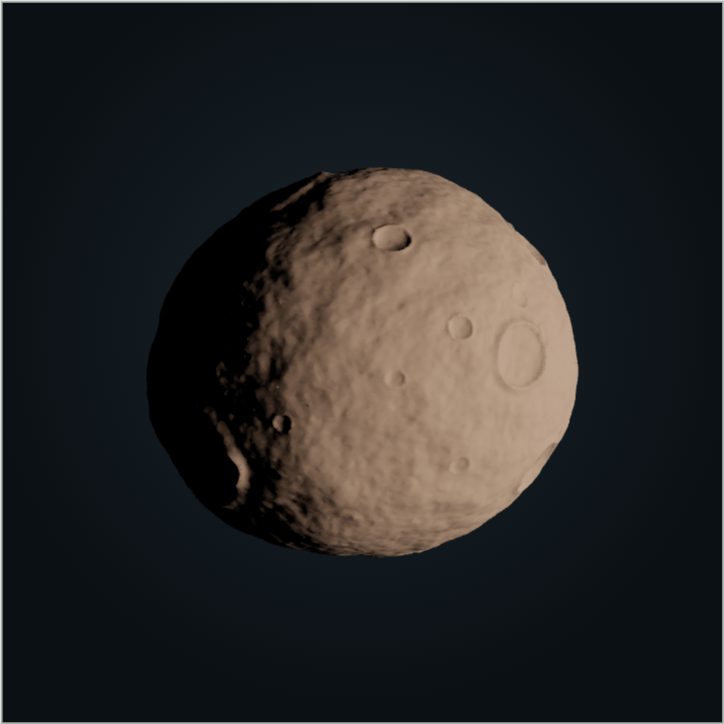
Shape, relief and colour are illustrative — no telescope has seen Dziewanna’s surface. A body 470 km across is close to a sphere; the model is slightly flattened and elongated, in line with its small brightness variation (0.12 mag), but the real axes have not been measured. Icy, yet slightly reddish: photometry shows Dziewanna is redder than the Sun (g′−r′ = 0.80 ± 0.02; Benecchi & Sheppard 2013, AJ 145, 124). Ice makes up much of its material, but the surface colour comes mainly from darker admixtures — for trans-Neptunian objects usually linked to organic compounds altered by radiation. The model’s tint is illustrative.
The side lighting is illustrative: from Earth Dziewanna is always seen almost fully lit (phase angle below 2°).
How big is it?
Dziewanna is about 470 km across: half the size of Ceres, the largest body in the asteroid belt, and a fifth of Pluto. Next to the Moon it is still tiny.
Sources and notes
Ceres 939.4 km (Dawn), Pluto 2377 km (New Horizons), Moon 3475 km: NASA — Ceres, NASA — Pluto, NASA — Moon. Dziewanna: Pál et al. 2012, A&A 541, L6.
If Dziewanna stood in Poland
A sphere 470 km across, sunk halfway into the ground near Piątek — the traditional centre of Poland. It would rise 235 km, higher than half the altitude of the International Space Station, so it only fits in a view from high above.
Sources and notes
True scale: the Earth as a sphere of radius 6371 km, Dziewanna 470 km across (thermophysical model, Herschel; Pál et al. 2012). Country borders: Natural Earth 1:50m (public domain). Centre: Piątek, 52.07° N 19.48° E — the traditional symbol of Poland’s centre; in 2018 surveyors who included sea areas pointed to Nowa Wieś near Kutno, a few dozen kilometres away. Illustrative lighting (low Sun in the west).
Where is it now?
Positions of the Sun, the planets and Dziewanna at the chosen moment. Distances are to scale, body sizes enlarged. One orbit takes several centuries, so the “10 years/s” buttons are best for watching it move.
More controls: backwards, date, jumps, cameras
Sources and notes
The Kuiper belt and background stars are illustrative. Positions: planets — astronomy-engine; Dziewanna — JPL Horizons ephemerides 1900–2100.
What does the Sun look like from there?
From about 34 au the Sun is a dazzling point of magnitude about −19: some 350 times brighter than the full Moon in our sky, yet about 1,150 times fainter than the Sun seen from Earth. Its disc is about 1 arcminute across — roughly the limit at which the human eye can tell it from a point. Light takes almost 5 hours to travel from there to us.
Sources and notes
A calculation, not a measurement: the Sun's magnitude at distance r (in au) is −26.74 + 5·log₁₀ r; for r = 33.9 au this gives −19.1. Full Moon: −12.7. Angular diameter of the Sun: 1919″ / r ≈ 57″. Dziewanna is now close to perihelion (22 October 2038); at aphelion, in about 290 years, the Sun will shine several times fainter from there.
Can Dziewanna be seen?
Not from Poland — but it can be photographed from the southern hemisphere. Between 2026 and 2040 Dziewanna never rises above the horizon in Kraków or Warsaw. It sits so far south in the sky (declination about −47° to −53°) that even at its best it stays several degrees below the horizon. It is also faint: about magnitude 19.5, within reach of large telescopes — and only from the southern hemisphere.
Sources and notes
Our own calculation from JPL Horizons tables (daily positions, 2026–2040, JPL orbit solution no. 12): highest culmination altitude h = 90° − |φ − δ| for the latitudes of Kraków (50.06° N) and Warsaw (52.23° N), without refraction. A negative altitude means the object does not rise. Brightness is predicted with the H–G model, not measured.
When is it best seen?
- Calculating…
It is best seen at opposition: the Earth lies between the Sun and Dziewanna, which culminates at midnight. From Poland — in no year from 2026 to 2040. The button moves the simulation and the map below to that date.
Where on Earth can it be seen?
Calculating…
Show table: observatories and Poland
Sources and notes
Our own calculation for the 24 hours from 12:00 UTC: every 15 minutes, the altitudes of Dziewanna and the Sun on a 2° × 2° grid; only times when the Sun is more than 18° below the horizon (astronomical night) count. Dziewanna’s position from JPL Horizons ephemerides, the Sun and sidereal time from astronomy-engine. Accuracy about 0.5° (no refraction, parallax or precession). Brightness from the H–G model. Observatories: approximate coordinates, an illustrative selection. Land outlines: Natural Earth 1:110m (public domain).
Distance from the Earth
Every year the Earth catches up with Dziewanna and moves away again, so the distance swings by about 2 au over a year. On top of that comes the slow motion along the orbit: Dziewanna passes perihelion in 2038 and then recedes for almost three centuries.
Sources and notes
Our own calculations from JPL Horizons ephemerides (1900–2100) and the astronomy-engine library; after 2100 a Keplerian approximation.
Upcoming oppositions
| Date | Distance from the Earth | Magnitude V |
|---|
If it hit the Earth
A thought experiment. Dziewanna cannot collide with the Earth: its orbit never comes closer to the Earth’s orbit than about 31.6 au. What do calculations say about an impact by a body this size — and how far apart are they?
Popular impact calculators (e.g. the Earth Impact Effects Program, Collins et al. 2005) do not apply to a body 470 km across: they ignore the Earth’s curvature and global effects. Instead we compare the impact energy with ocean-vaporisation thresholds from studies of giant impacts on the early Earth.
How much of the oceans would it boil off? Two approaches
Diameter thresholds for vaporising the whole ocean
- Minutes to hours: impact and ejection of material; energy of order 10²⁷–10²⁸ J.
- Years to a century: the rock-vapour atmosphere cools within about 1–100 years.
- Millennia: hostile surface conditions persist for thousands of years.
Sources and notes
Diameter 470 km; Dziewanna’s mass and density have not been measured. 11.2 km/s is the lowest possible speed of an impact on the Earth. One ocean mass needs about 5·10²⁷ J.
Approach 1: Sleep et al. 1989 (Nature 342, 139) and Zahnle et al. 2020 — 25–50% of the energy goes into vaporisation; threshold 350–440 km. Approach 2: Citron & Stewart 2022 (Planetary Science Journal, DOI 10.3847/PSJ/ac66e8) — a fit to 3D simulations of 1500–3400 km bodies, extrapolated here; threshold about 710–860 km. Svetsov 2005: about 500 km. Both approaches are used outside the range they were built for, and the thresholds refer to rocky bodies — hence the spread. Time scale: Citron & Stewart 2022 (silicate atmosphere), Sleep et al. 1989 (surface conditions). Earth MOID: JPL SBDB.
Discovery
Dziewanna was discovered on 13 March 2010 with the 1.3-metre Warsaw Telescope at Las Campanas Observatory in Chile. The discoverers are Andrzej Udalski, Scott S. Sheppard, Marcin Kubiak and Chad A. Trujillo. It received the provisional designation 2010 EK139. It later turned out to have been caught on earlier images — the oldest observation used in the orbit dates from 2002.
The name was announced by the Minor Planet Center in 2018. The citation begins: Dziewanna is a Slavic Goddess of the wild nature, forests and the hunt.
Full text: JPL Small-Body Database.
Where does the name come from? The goddess Dziewanna
Distant objects beyond Neptune are named after deities from the mythologies of various peoples — the Minor Planet Center requires it. The discoverers from the University of Warsaw Astronomical Observatory chose a Slavic goddess and kept the Polish spelling. The naming citation describes Dziewanna as a young, golden-haired goddess of wild nature, forests and the hunt who brings spring; yellow mullein flowers are said to be her symbol and dried stalks torches at her festivals. This is the text of the 2018 dedication, not a description confirmed by historians. A coincidence links it to the chronicler: one orbit takes about 570 years, so Dziewanna was last closest to the Sun in the 1460s — just when Jan Długosz was writing the chronicle in which he recorded the goddess's name.
Read more: what the chronicle and historians say
What is actually known?
The oldest record of the name is the chronicle of Jan Długosz (Annales, book I, written from 1455). Długosz equates her with the Roman Diana, and Marzanna with Ceres: Diana lingua eorum Dzewana et Ceres Marzyana vocatae
— “Diana, called Dziewanna in their language, and Ceres, called Marzanna”. He wrote several centuries after Poland's baptism and described the pagans on the model of the classical Olympus, so historians treat his list of gods with caution.
Henryk Łowmiański (1984) regarded both figures as the chronicler's creation — ritual effigies rather than deities. Marek Cetwiński (2025) writes that the origin of the name is unknown and that it cannot be settled whether Długosz invented it; he links it with the Polish word for “wild” as a fitting name for a goddess of forests. The custom of drowning an effigy in spring is attested in Polish synodal statutes of 1420, but Cetwiński looks for its roots in Christian liturgy rather than in an old cult.
The mullein plant (Verbascum, Polish dziewanna) has a name older than the chronicle: the word is attested in 1419 and comes from “to wonder” (Proto-Slavic *diviti, possibly originally “to shine”). Whether the goddess was named after the plant or the other way round, the sources do not say. Golden hair, a festival calendar or torches as her rite are later additions, not testimony from pagan times.
The same goddess already has a place in the Solar System: the Devana Chasma rift on Venus, named in 1982 after a “Czechoslovakian goddess of hunting” (as the IAU catalogue puts it).
Sources and notes
Naming citation: JPL Small-Body Database (MPC batch of 25 Sep 2018). Naming rule and the discoverers' choice: UW Astronomical Observatory, 4 Oct 2018 (in Polish). Długosz, Annales, book I — Latin text (public domain), our translation. H. Łowmiański, “Zagadnienie politeizmu słowiańskiego”, Przegląd Historyczny 75 (1984), pp. 677–679. M. Cetwiński, “Rudolf's Catalogue of Magic and Jan Długosz's Olympus”, Slavia Antiqua 66 (2025), pp. 412–414. The plant: Polish Academy of Sciences dictionary (WSJP). Venus: IAU/USGS, Devana Chasma. No images of the goddess are shown: no early depiction survives, and modern visions are reception, not evidence.
Data
Show orbit and size data
Values from the NASA/JPL Small-Body Database, refreshed daily, and from scientific papers. Every row links to its source.
| Parameter | Value | Source |
|---|
Where do the numbers come from?
- Orbit
- Orbital elements and absolute magnitude from the JPL Small-Body Database. These are osculating elements: the ellipse that best describes the motion at a given instant (the epoch). The planets, Neptune above all, keep changing it, so the orbital period given for one epoch is not a fixed interval between successive perihelia.
- Distance from the Sun
- In the header it is computed from the orbital elements (Keplerian ellipse); within a few years of the epoch it differs from JPL Horizons tables by less than 0.01 au.
- Size
- The diameter comes from thermal emission measured by the Herschel Space Observatory and depends on the model used. Simpler models in the same paper give about 450 to 535 km from the same data.